2019年3月15日金曜日

A group of 10 Japanese Students from Musashino University visited RITM

10 Students from the Faculty of Pharmaceutical Sciences in Musashino University came to visit RITM facilities on March 12, 2019.  The students had a small talk first with Dr. Saito at Tohoku Room before heading to Director's Office Conference Room for an overview of RITM before the tour started.

Their visit is part of a study tour to the Philippines with an aim to observe what measures are taken against medical problems in the country and see how it differs from the ones in Japan. They donate money to support vaccination programs in some of the Asian countries in South, East and the Pacific Ocean through NGO in Japan.  They generate money by selling old textbooks obtained free of charge from the graduating students.


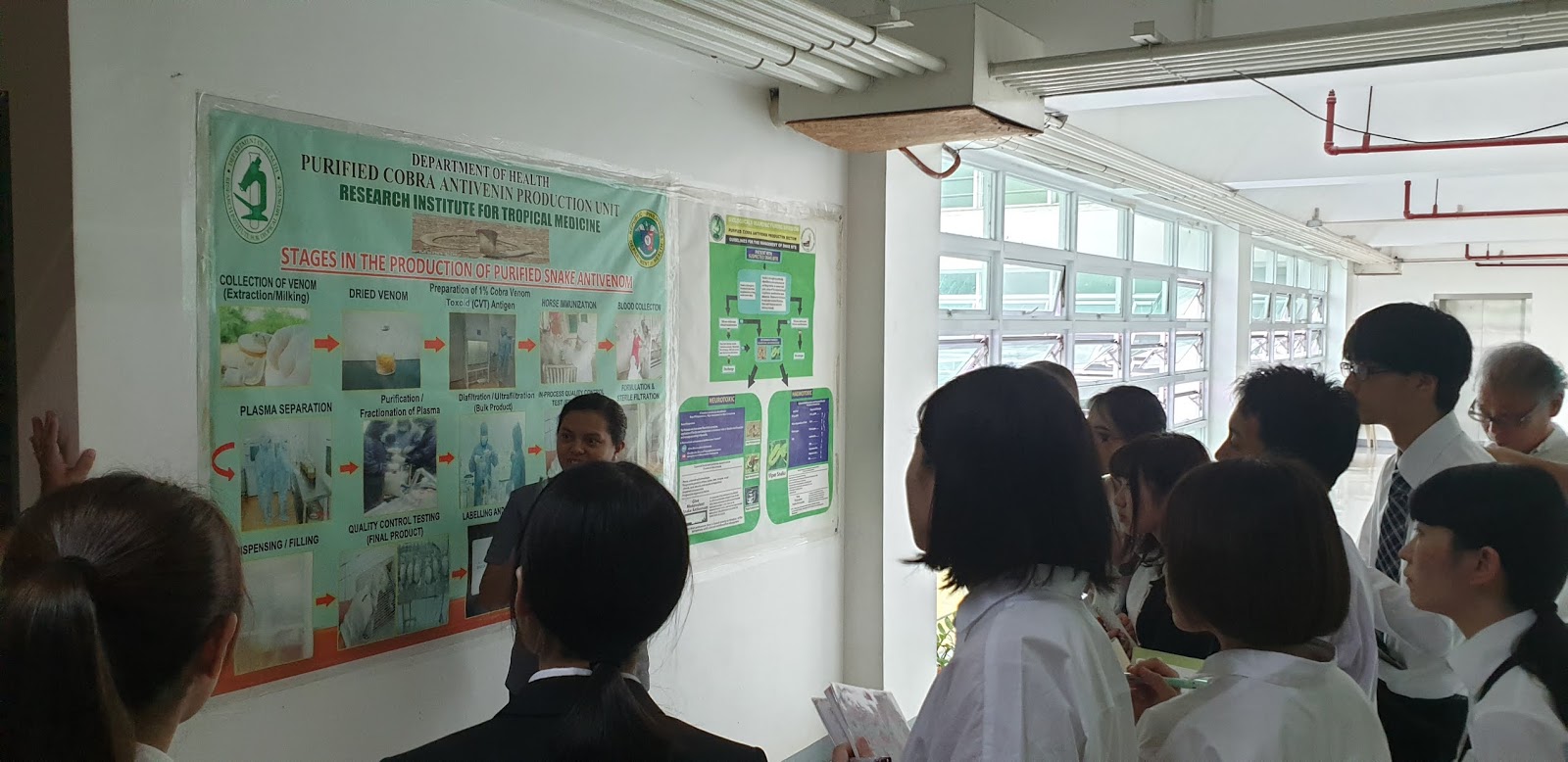
The students visited the Biologicals Manufacturing Division (BMD) and Dr. Noel Macalalad, Chief of BMD welcomed them.  Dr. Macalalad and the Supervisor explained the process done by the department in handling venom. 


They passed by BSL3 Lab and Emergency Room.


The students went to the the Animal Bite Clinic and the Pharmacy, they checked the facilities and the staff answered the student's inquiries.


The visit went on smoothly, there was interaction among students and the facilitators.  Dr. Saito presented the JAPOHR Project to the students. 

The 2-hour visit ended with a group picture!


And another wacky picture!


Short training in Oita day2

On March 12, we visited the Oita Animal Protection Center.
The purpose was to learn about stray dog measures being taken in Japan.

This facility had just opened last month.
First of all, Dr. Kobayashi and Dr. Ookuma explained the outline and activities of this facility.
This facility is not only as a dog Impound but also as training classes for owners and adaption.

The facilities included instruction for animal protection during disasters, a model room for breeding cats in a house, a facility for treating injured, and a facility for breeding dogs and cats to be adopted.


Then we went to the place to euthanize a dog or cat.
The bodies of euthanized animals are transported to the incinerator.

This is "the Flower of Life". The bodies of animals that are incinerated after euthanasia become ashes and bring life to flowers.

Similar activities are being carried out in the Philippines, but these activities are by the municipality level, sufficient facilities have not been provided.
It is a future subject to cope with animal protection as well as control of stray dogs.

In the afternoon, we had a welcome party with our laboratory staff!

2019年3月12日火曜日

Short training in Oita day 1

From March 11, Dr. Milagros R. Mananggit and Ms. Gina R Manlapig participated in the short training in Oita.

Today, Dr. Yamada, Ms. Yoshida, and Ms. Noguchi explained how to measure anti-rabies antibodies by RFFIT and how to detect viral RNA by real-time RT-PCR.

In the afternoon, Dr. Nishizono explained the outline of the training and explained about our research.

In the evening, we enjoyed Oita special dishes.


In this training, we are planning to diagnosis rabies, visit an animal protection facility, and visit animal quarantine.

I hope that this training will be useful for future measures against rabies.

2019年3月10日日曜日

Visit to Tacloban

On 26-27 February, we visited Tacloban for the technical support of rabies diagnosis and histopathology in Regional Animal Disease Diagnostic Laboratory 8 (RADDL8). In 2013, The big typhoon Haiyan land Tacloban and a lot of people died.

RADDL8 was also damaged but thanks to the support, the building was reconstructed and many types of equipment are installed.

The purpose of this project is to establish one health approach. to diagnose rabies is one of the important roles in this project. In this visit, I was able to hear the diagnosis of rabies that is being done at RADDL 8 and the measures being done in Region8.

By knowing the problem of rabies diagnosis and measures in the Philippines, we would like to develop activities to make future activities available throughout the Philippines.

2019年3月7日木曜日

13 Japanese students from Tokyo Institute of Technology (TIT) visited RITM on March 7, 2019

Today March 7, 2109, we at JAPOHR project had visitors from Tokyo Institute of Technology (TIT).  13 Engineering students came to check on the facilities and services offered by the Research Institute for Tropical Medicine (RITM).  The TIT students visit countries overseas as part of their Global Science and Technology Development Course.  Their aim is to deepen the understanding of international cooperation, especially cooperation in the field of science and technology.
Initially, they had a courtesy call with Dr. Quiambao, Chief, Clinical Research Division of RITM.
Brief background from the Special Pathogens Laboratory (SPL) and Veterinary Research Department (VRD) was visited to have an overview of the department activities.  They also visited the Animal Bite Clinic where the bite and rabies infected patients were treated.

The visit was interactive as students get to ask questions.  Before ending the visit,  Dr. Nobuo Saito, Deputy Principal Investigator did present the JAPOHR project to have a better understanding of it.

Below are some of the pictures of today's visit.


Technical Working Group Workshop at RITM Balmis Conference Room

On March 4, 2019, a workshop for the Technical Working Group (TWG) was held in RITM at Balmis Conference room.  It was facilitated by Dr. Nobuo Saito, the Deputy Principal Investigator of the JAPOHR Project and Dr. Quiambao of the Clinical Research Division of RITM.  It was a 5hour workshop attended by Japanese and Filipino collaborators.  The aim of this TWG is to provide technical inputs towards the achievements of project expected outputs.  Such outputs are: (1) Novel diagnostic methods for rabies in canines and humans are established in testing facilities in the Philippines; (2) Rabies network model is developed in the target area of the project. (3).

There are 5 TWG: Animal rabies diagnosis; Human rabies diagnosis; rabies network model; RAPINA for human; and RAPINA for the animal.

Over the discussions, clearer group purpose was made in order to achieve the project target results.

Here are some of the images that took place on that day....


Indeed the project success is from the cooperative collaboration of Japanese and Filipino experts!

2019年2月7日木曜日

Meeting with GARC member in the Philippines

On 7th Feb, 2019

We have a meeting with GARC Philippines.
The aim of this meeting is to show JAPOHR project to them and to seek possible collaboration.

GARC (Global Alliance for rabies control) conducted great works in the Philippines.
A recent published paper by Chari Amparo et al described rabies situation in the Philippines.
http://journals.plos.org/plosone/article?id=10.1371/journal.pone.0199186#pone-0199186-g009

GARC has conducted a community project in Muntinlupa.
Ms Chari explained their well-developed data system for rabies
https://rabiesalliance.org/news/garcs-new-community-based-rabies-surveillance-tool-released-testing-and-training   

Hope we can collaborate with them and their support for our project near future